
OpenAI DeployCo vs. Microsoft Azure: The New Battleground for Enterprise AI
OpenAI DeployCo vs. Microsoft Azure: The New Battleground for Enterprise AI :For the past few years, the choice for U.S. enterprises wanting to harness GPT-4 was simple: you either went straight to the source at OpenAI or you used Microsoft Azure OpenAI Service for that “enterprise-grade” security blanket.
However, the launch of The Deployment Company (DeployCo)—OpenAI’s massive $10 billion joint venture with private equity titans like TPG and Bain Capital—has fundamentally changed the map.
If you are a CTO or a business leader in 2026, you are no longer just choosing a platform; you are choosing a deployment philosophy. Here is the definitive breakdown of how OpenAI’s new powerhouse, DeployCo, stacks up against the established giant, Microsoft Azure.
The emergence of OpenAI’s DeployCo has fundamentally shifted the enterprise AI landscape, creating a high-stakes rivalry with Microsoft Azure OpenAI Service. While Microsoft Azure remains the gold standard for companies seeking cloud-native scalability, regional compliance, and seamless integration with the Microsoft 365 ecosystem, The Deployment Company (DeployCo) offers a more hands-on, “consultative” approach. Backed by a $10 billion joint venture with private equity leaders like TPG, DeployCo differentiates itself by embedding Forward Deployed Engineers directly into organizations to build custom, agentic workflows. For U.S. business leaders, the choice now boils down to infrastructure vs. implementation: leveraging Azure’s robust self-service platform or opting for DeployCo’s high-touch, ROI-focused deployment model designed to accelerate AI transformation across private equity portfolios.
Image Source: Gemini AI
1. The Core Philosophy: “Do It For Me” vs. “Build It Yourself”
The biggest differentiator between these two paths isn’t the underlying model—it’s the level of human intervention.
- OpenAI DeployCo (The “Special Ops” Model): Emulating the Palantir playbook, DeployCo isn’t just a software portal. It provides Forward Deployed Engineers (FDEs) who physically or virtually embed within your organization. They don’t just give you the API keys; they map your workflows, identify bottlenecks, and build the custom AI agents for you.
- Microsoft Azure (The “Infrastructure” Model): Azure remains the king of Self-Service. It provides a robust, scalable environment with “Lego bricks” (Azure AI Studio, Prompt Flow, and Cognitive Services). It is designed for companies with established internal dev teams who want to build and manage their own solutions on a familiar cloud stack.
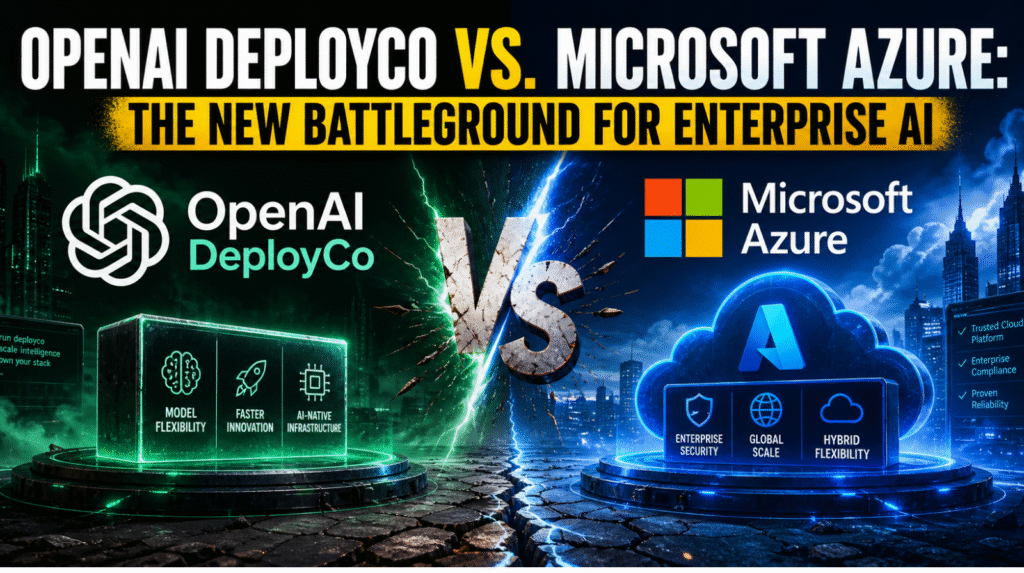
Image Source: chatgpt AI
2. Governance and Economics
The financial structures of these two options couldn’t be more different.
| Feature | OpenAI DeployCo | Microsoft Azure OpenAI |
| Financial Entry | Often tied to PE portfolio agreements or massive bespoke contracts. | Standard Pay-as-you-go or Enterprise Agreement (EA) credits. |
| Primary Incentive | Focused on Value Capture—OpenAI guarantees a 17.5% return to its PE backers by proving AI ROI. | Focused on Consumption—Microsoft wins when you use more compute and storage. |
| Ownership | Highly bespoke; may involve shared IP or specific vertical rights. | You own the application layer; Microsoft owns the cloud infrastructure. |
Go to Homepage
3. Security, Privacy, and Compliance
For many U.S. firms in regulated industries (Healthcare, Finance, Defense), this is the deal-breaker.
- The Azure Advantage: Microsoft has a decades-long head start in compliance. With Azure Entra ID (formerly Active Directory), SOC2/3, and HIPAA-ready environments, it is the “safe” choice for CISOs. Your data stays within your specific regional tenant, and Microsoft’s “Responsible AI” filters are baked into the infrastructure.
- The DeployCo Proposition: While DeployCo offers high-level security, its selling point is Direct Access. Because DeployCo engineers are embedded, they can navigate complex data silos that third-party APIs often struggle with. However, being a newer entity (registered in Delaware as an LLC), it is still building the same level of bureaucratic trust that Microsoft enjoys.
4. The “Frontier” vs. The “Ecosystem”
- OpenAI’s Frontier Alliances: DeployCo works in tandem with the “Frontier Alliance,” a program where OpenAI engineers pair with consultants from McKinsey, BCG, and Accenture. If your goal is a total business transformation—reshaping how your 10,000 employees work—this “consulting-heavy” approach is the primary draw.
- Microsoft’s 365 Ecosystem: If your company lives in Teams, Outlook, and Excel, Azure is the path of least resistance. The integration between Azure AI and Microsoft 365 Copilot creates a “closed loop” that DeployCo, as an outside entity, currently cannot match in terms of sheer desktop ubiquity.

Image Source: Gemini AI
The Verdict: Which Should You Choose?
Choose OpenAI DeployCo if:
- You are part of a Private Equity portfolio (especially TPG, Bain, or Brookfield) where the path to adoption is already paved.
- You have a massive implementation gap—you have the data, but no internal team to build the agents.
- You need bespoke, agentic AI that requires engineers to understand your specific, non-standard business logic.
Choose Microsoft Azure if:
- You have an existing Microsoft footprint and want to leverage your current Enterprise Agreement (EA).
- You have an in-house engineering team that wants full control over the development lifecycle.
- Security and Compliance are your #1 priority, and you require regional data residency and established identity management.