
Why is Bitcoin Dropping While Gold Hits New Highs in 2026?
Why is Bitcoin Dropping While Gold Hits New Highs in 2026? :The financial landscape of February 2026 has presented a startling paradox for American investors. For years, the rallying cry of the “crypto-curious” was that Bitcoin is “Digital Gold”—a decentralized safe haven that would shine when the traditional world stumbled.
However, as we move through the first quarter of 2026, that narrative is facing its toughest trial yet. While Gold has surged past historic milestones, reclaiming the $5,200 level, Bitcoin has endured a brutal February, sliding roughly 24% and struggling to hold the $65,000 mark.
If you are wondering why your “digital hedge” is bleeding while the “yellow metal” is soaring, you aren’t alone. Here is a deep dive into the macroeconomic forces, trade policies, and institutional shifts driving this Great Divergence.
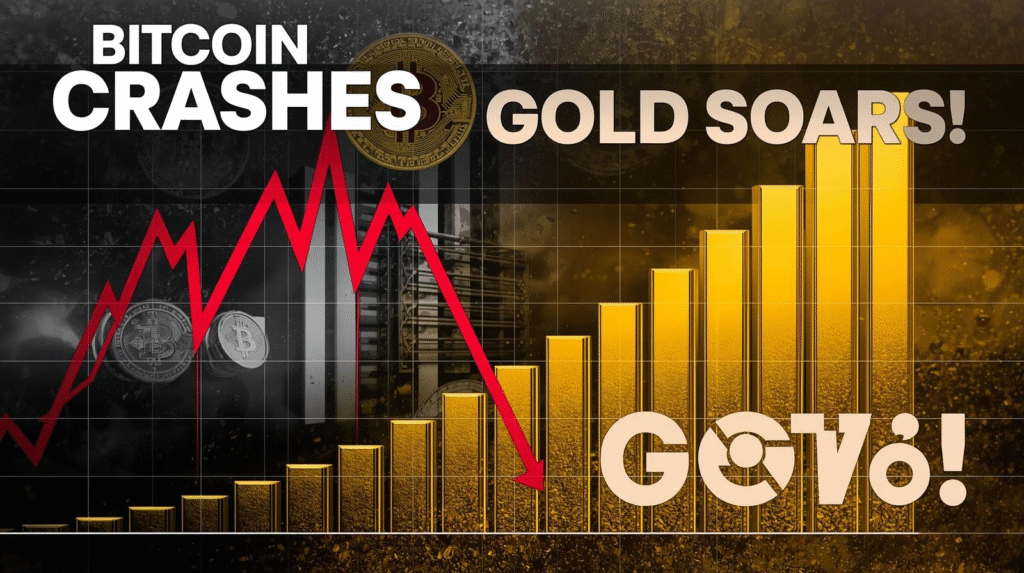
Image Source: Canva AI
1. The “Risk-Off” Rotation: Gold as an Anchor, Bitcoin as High-Beta
The primary driver of this split is a shift in global risk appetite. In early 2026, the U.S. economy is navigating a “risk-off” environment. When investors are scared, they look for assets with centuries of proven stability.
- Gold’s Role: Gold is currently behaving as the ultimate insurance policy. Driven by central bank accumulation (now comprising over 80% of U.S. reserves) and geopolitical tensions—ranging from conflicts in the Middle East to disputes over Greenland—bullion has become the “anchor” for nervous portfolios.
- Bitcoin’s Reality: Despite its “digital gold” label, Bitcoin is currently trading more like a high-beta tech stock. It is highly sensitive to liquidity. When the market moves to “de-risk,” speculative and volatile assets are the first to be sold.
2. The “Tariff Shock” and Dollar Strength
The re-introduction of aggressive trade policies in 2026 has fundamentally altered the math for crypto investors. President Trump’s announcement of 10%–15% global tariffs has sent shockwaves through the market.
- Inflation vs. Liquidity: While tariffs are technically inflationary (which should help Bitcoin), they also lead to “sticky” interest rates and a stronger U.S. Dollar.
- The Squeeze: A stronger Dollar typically exerts downward pressure on Bitcoin. Furthermore, the threat of a trade war has led many institutional desks to trim their “alternative” holdings in favor of cash and gold to stay liquid during the uncertainty.
Go to Homepage
3. Institutional “Exit Ramps”: The ETF Paradox
In 2024, the arrival of Spot Bitcoin ETFs was hailed as the ultimate bullish catalyst. In 2026, we are seeing the double-edged nature of that sword.
Recent data shows that U.S.-listed Bitcoin ETFs, like BlackRock’s IBIT, have seen significant outflows (over $200 million in single sessions this month). Institutional investors, who now control a massive portion of the Bitcoin supply, use these ETFs as “exit ramps” during macro turbulence. In contrast, Gold ETFs have seen a resurgence as hedge funds rotate their Q4 2025 crypto gains back into the stability of the precious metal.
4. Regulatory Weight: The GENIUS Act & CLARITY Act
The U.S. regulatory landscape is also playing a role. While the GENIUS Act (passed in July 2025) provided a framework for stablecoins, the broader CLARITY Act—designed to define digital commodities—faced legislative hurdles in early 2026.
This legal “gray zone” has made some Wall Street players hesitant to “buy the dip” in Bitcoin, whereas Gold enjoys total regulatory and historical clarity.
Image Source: Canva AI
Technical Outlook: Where is the Floor?
For those looking at the charts, the divergence is clear:
- Gold ($XAU): Having broken above the $5,160 Fibonacci resistance, analysts at Goldman Sachs and J.P. Morgan are now eyeing $5,400 as the next target for late 2026.
- Bitcoin ($BTC): The digital asset is currently testing its 200-week moving average near $58,500. This level has historically served as a “generational floor.” If Bitcoin can hold this support, the “digital gold” narrative may see a spring revival. If it breaks, a slide toward $50,000 remains on the table.
The Bottom Line for U.S. Investors
The 2026 “decoupling” of Bitcoin and Gold serves as a reminder that Bitcoin is still an evolving asset. While it may one day serve as a global reserve, it currently remains tethered to the tech-heavy Nasdaq and global liquidity cycles.
Gold remains the king of the “crisis trade,” while Bitcoin remains the king of the “growth trade.” For a balanced 2026 portfolio, many American investors are finding that it isn’t a matter of either/or, but rather how to use Gold to protect against the very volatility that makes Bitcoin so attractive during a “risk-on” rally.