
“Risk of leveraged single-stock ETF implosion in 2026”
“Risk of leveraged single-stock ETF implosion in 2026” :The year 2025 has seen an unprecedented explosion in the popularity of leveraged single-stock ETFs (LSSEs). With products tracking titans like Nvidia (NVDL), Tesla (TSLL), and Microsoft now staples in retail portfolios, the “gamification” of the stock market has reached its peak. However, as we look toward 2026, a mathematical and macroeconomic storm is brewing that could lead to a massive implosion for these high-stakes vehicles.
For the uninitiated, these funds offer 1.5x, 2x, or even proposed 5x daily returns of a single company. While the gains can be breathtaking, the “Risk of Leveraged Single-Stock ETF Implosion in 2026” is not just a theory—it is a mathematical certainty for many long-term holders.
The Mechanics of a “Ticking Time Bomb”
The primary risk of LSSEs isn’t just that the underlying stock might go down; it’s how they behave when the market goes sideways. These funds are designed for daily resets. This means they are engineered to deliver a multiple of a stock’s performance for exactly one trading session.
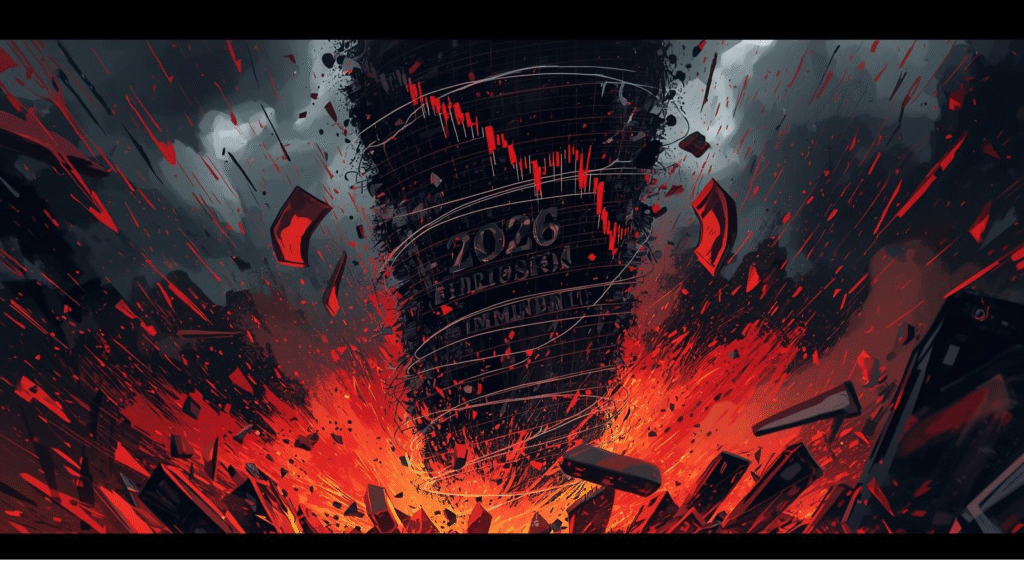
Image Source: Canva AI
The Math of Volatility Decay (Beta Slippage)
When you hold a leveraged ETF for more than a day, you encounter “volatility decay.” If a stock is choppy—rising 10% one day and falling 10% the next—the underlying stock is down only 1%. However, a 2x leveraged ETF doesn’t just lose 2%; it loses more because of the compounding effect of the daily reset.$$\text{Ending Value} = (1 + k \cdot R_1) \times (1 + k \cdot R_2) \dots$$Where $k$ is the leverage factor and $R$ is the daily return. In a volatile 2026 market, this decay can “bleed” an account dry even if the underlying stock remains relatively flat over the year.
Why 2026 is the Danger Zone
Market analysts are increasingly calling 2026 a “pivot year.” Here is why the risk of implosion is spiking:
1. The AI ROI Reality Check
The massive capital expenditures (CapEx) in AI that fueled the 2024-2025 bull run are expected to face a “show me the money” moment in 2026. If companies like Nvidia or Microsoft show even a slight deceleration in earnings growth as the market moves from the “build-out” phase to the “adoption” phase, the resulting volatility could be catastrophic for 2x and 3x LSSEs.
2. Stretched Valuations
As of late 2025, the S&P 500’s Shiller CAPE ratio is near historic extremes (approx. 39x). When valuations are this stretched, even minor macro shocks—such as a credit crunch or geopolitical shifts—can trigger 10-15% single-day “flash crashes” in individual stocks.
3. The “Zero-Out” Scenario
The most terrifying risk is the total liquidation of a fund. For a 3x leveraged ETF, a single-day drop of 33.3% in the underlying stock effectively wipes out the fund’s value to zero. For 2x funds, the “death number” is 50%. While a 50% drop in a mega-cap stock like Apple sounds impossible, in a systemic panic or a “Black Swan” event in 2026, liquidity can vanish, and circuit breakers may not be enough to save a leveraged wrapper.
Go to Homepage
The Hidden Costs: Financing and Counterparty Risk
LSSEs don’t just borrow money for free. They use total return swaps with major banks. As we head into 2026, two hidden factors are eating into returns:
- Rising Swap Spreads: Banks are charging higher fees to facilitate these risky bets.
- Financing Rates: With interest rates remaining “higher for longer” to combat stubborn inflation, the cost of maintaining 2x leverage is often 8–10% annually, a cost that is “felt but not seen” as it’s netted out of the ETF’s daily performance.
Image Source: Canva AI
How to Protect Your Portfolio
| Risk Factor | Mitigating Action |
| Volatility Decay | Limit holding periods to < 48 hours. |
| Concentration Risk | Diversify into “Titans” ETFs (multi-stock 2x funds) rather than single-stock funds. |
| Black Swan Events | Use “Hard Stop” orders to exit positions automatically during a crash. |
| Over-Leverage | Never allocate more than 1-2% of your total portfolio to LSSEs. |
How U.S. Investors Can Protect Themselves
- Know What You Own: If you hold these ETFs, be brutally honest. They are not buy-and-hold investments. They are sophisticated trading tools for professionals who monitor positions intraday.
- Use Strict Hedges and Time Limits: If you trade them, use airtight stop-loss orders (understanding they aren’t guaranteed in gaps) and never allocate more than a tiny portion of your risk capital. Consider them only for short-term, tactical bets measured in hours or days, not months.
- Seek Alternatives for Long-Term Exposure: Want leveraged exposure to a stock you believe in? Consider options strategies (like long-dated calls) where your risk is defined and limited to the premium paid. Or simply invest in the actual stock.
- Diversify, Diversify, Diversify: The classic rule remains your best defense. A portfolio concentrated in single-stock leveraged ETFs is a portfolio built on a cliff’s edge.
- Stay Informed, Not Fearful: Monitor the broader market environment, especially Fed policy and valuation metrics in the tech sector. In 2025, start reviewing any such holdings with increased skepticism.